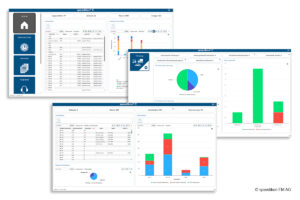

With our new “Tile Spotlight” series, we want to regularly introduce individual tiles from across the speedikon FM group and show how they support everyday work of our customers.
We’re starting with a topic that many companies deal with on a daily basis: maintenance.
In many organizations, maintenance still follows a familiar pattern. Action is only taken when something breaks down, when a deadline is suddenly due, or when a problem escalates.
Planning, execution, and documentation usually exist, but they are often handled in different systems or by different teams. For example, maintenance tasks might be planned in one tool, carried out based on emails or phone calls, and documented somewhere else afterwards
As a result, information gets lost along the way, and decisions are not always based on a complete overview. This leads not only to additional effort, but also to production delays, higher costs, and in some cases even safety risks if defects are discovered too late.
How the Maintenance tile supports your processes
Within speedikon® C, maintenance is handled as one continuous process.
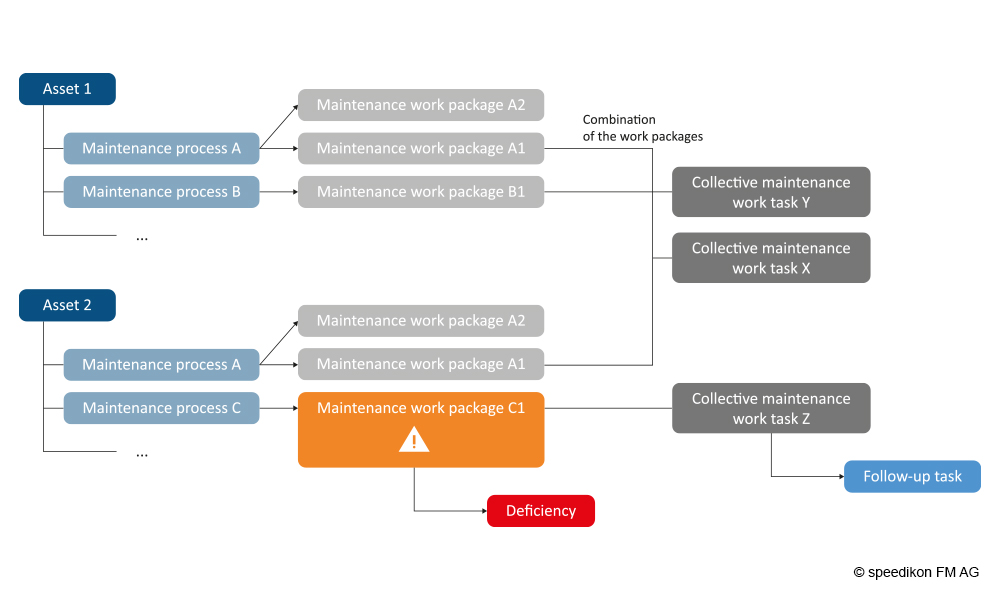
It starts with preparation. In this step, the user defines which technical assets need maintenance, what kind of work needs to be carried out, and when it should happen. For example, a facility manager can define that an air handling unit must be inspected twice a year, or that a system needs servicing after a certain number of operating hours.
Based on these definitions, the system automatically generates the corresponding work orders. This means that recurring tasks no longer need to be tracked manually, and important deadlines are not missed. At the same time, users can still create or adjust tasks whenever something unexpected happens. In the next step, the responsible person assigns these tasks to internal staff or external service providers. Deadlines and responsibilities are clearly visible at all times, helping to avoid situations where tasks are overlooked, duplicated, or left unfinished.
Completed work can be documented directly in the system, for example using mobile devices on site. The technician records what was done, notes any defects, and adds further details, all of which are linked directly to the relevant asset.
Once the work is completed, the results are reviewed and follow-up actions are defined. For example, minor issues can be scheduled for a later maintenance cycle, while critical defects can trigger immediate follow-up actions.
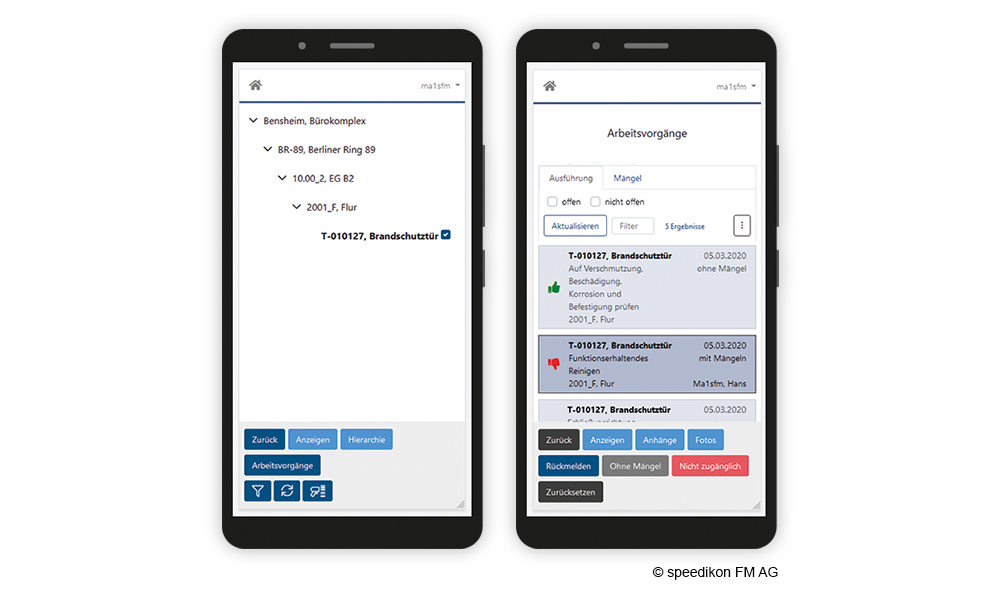
Over time, this creates a clear history for each asset, making it easier to understand recurring problems and plan future actions. This changes how maintenance is handled in everyday operations.
With the Maintenance tile, customers can turn maintenance from a series of isolated actions into a structured and traceable process.
Get in touch with us and let’s explore how you can increase transparency in your processes, make better-informed decisions, and move from reactive to structured maintenance.