With our “Tile Spotlight” series, we regularly take a closer look at individual tiles from across the speedikon FM Group and show how they support our customers.
This time, we are looking at something that is easy to overlook until one of them goes missing: keys.
For organizations managing large building and real estate portfolios, keeping track of keys and access rights can quickly become a substantial administrative task. Different locations have their own locking systems, employees and external service providers require different permissions, and some authorizations are permanent while others are only needed for a limited period.
And today, access management is no longer limited to conventional keys. Transponders, electronic access cards, and mobile access solutions via smartphones or tablets have become part of the picture as well. As the number of properties, users, access media, and individual permissions grows, locally maintained lists and manual processes become increasingly difficult to manage.
So how do you maintain a reliable overview of who has access to what?
When Manual Key Management Reaches Its Limits
Even well-organized companies can quickly reach the limits of manual Key Management. Multiple locations, changing users, individual access permissions, temporary handovers, and missing return records make it increasingly difficult to maintain an accurate overview. Processes that may once have worked with spreadsheets, local lists, or key cabinets can become an efficiency and security risk as organizations and their real estate portfolios grow.
One of our customers in the telecommunications sector experienced this on a particularly large scale. For years, keys for several thousand buildings were managed manually and independently at the individual locations. Each site maintained its own records, which meant that the quality of the information varied depending on when and how consistently it was updated. Changes were not always reflected across locations, and over time, different versions and outdated information made coordination increasingly difficult.
Keys were lost or assigned incorrectly, and determining who had access to individual properties required considerable effort. What had started as a decentralized administrative process was creating additional work, costs, and security risks.
By introducing Key Management in speedikon® C, the customer replaced these separate records with a browser-based system that can be used across locations. Authorized users now work with a shared, current information base instead of numerous locally maintained lists.
Who Has Access to What?
Central Key Management provides an overview of the locking systems and access media used across a building and real estate portfolio. Conventional keys can be managed alongside transponders, electronic access cards, and mobile access solutions, allowing different access technologies to be handled within the same environment.
Keys and other access media can be assigned to individuals, departments, organizational units, or external service providers. This makes it possible to trace who has received an access medium and which buildings or rooms the corresponding authorization covers.
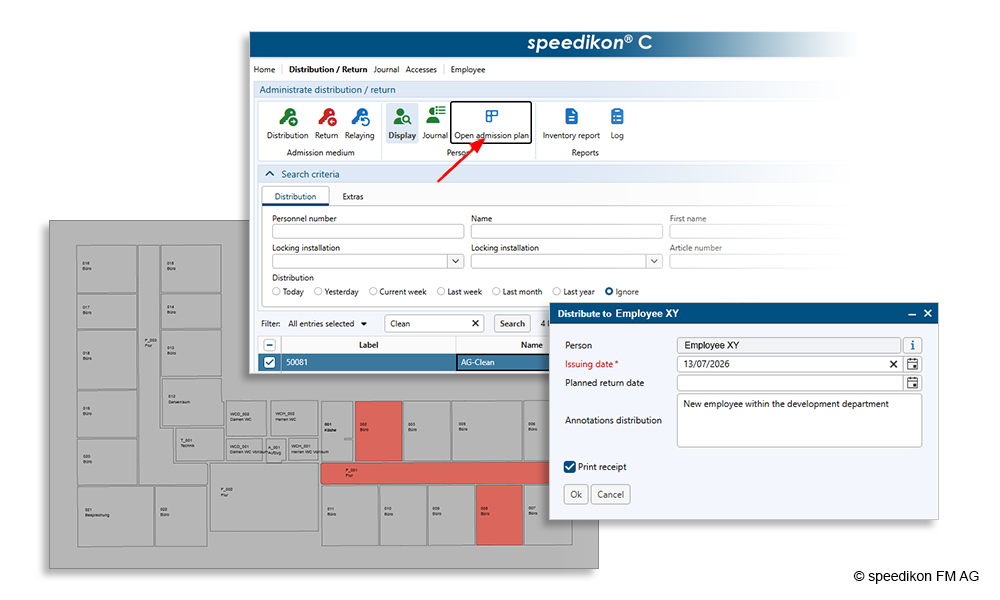
But this information does not have to remain an abstract list of permissions. speedikon® C can visualize access directly in the floor plan, showing which rooms and areas are associated with a particular access authorization. Instead of working through individual entries to understand where someone can go, users can see the corresponding areas in their spatial context. Especially in larger buildings and more complex portfolios, this makes access relationships considerably easier to understand.
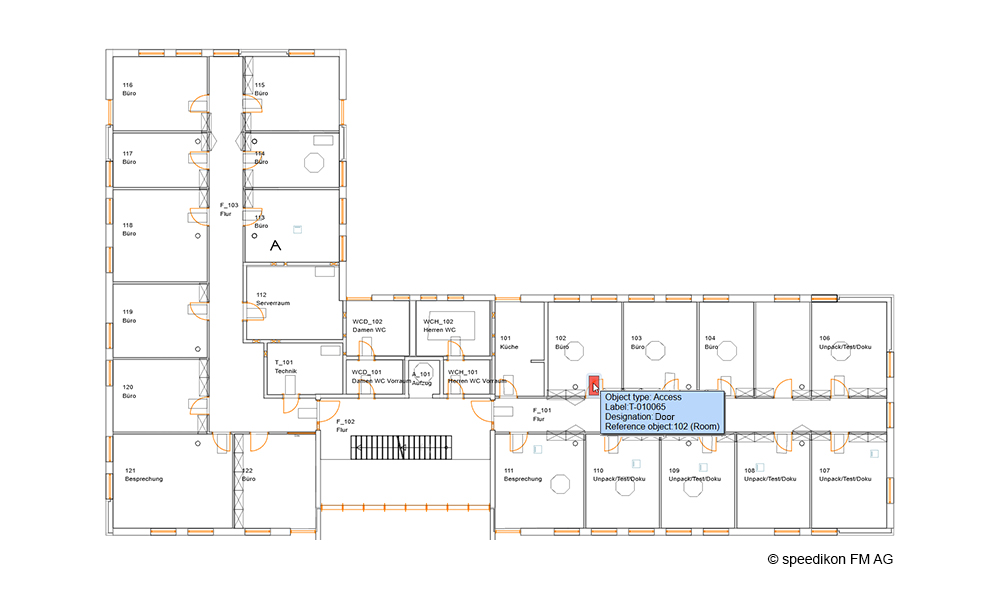
Depending on the configured permissions, individual locations can manage their own information while relevant data can also be made available across sites. The result is not only a central source of current information, but also a visual way of understanding who can access which parts of a building.
What Happens After the Handover?
Keeping track of the initial assignment is only part of Key Management. Returns become particularly important when access is intended to be temporary.
External service providers may require access only for the duration of a project, while employees changing positions or locations may no longer need access to particular areas. Without a structured process, temporary assignments can easily remain active longer than intended.
In speedikon® C, the issue and return of keys and other access media can therefore be documented directly within the system. A planned return date can be recorded for temporary assignments, while reminders help responsible teams keep track of outstanding returns and make it easier to identify access media that should already have been handed back. The corresponding access plan can also be opened from the process, providing a visual overview of the areas associated with the respective access medium or assignment.
The information remains available even when responsibilities within the organization change. Knowledge about key assignments is no longer dependent on an individual employee, a local spreadsheet, or a particular location knowing where the latest version of a list is stored.
The same continuity is important when the access infrastructure itself changes. Locking systems are replaced, access technologies develop, and assignments change over time. Rather than losing the previous state whenever such changes are made, the history remains transparent. This makes it possible to understand not only the current access situation, but also how it has developed. If a key or another access medium is lost, its existing assignment can likewise be traced and followed up.
Keeping Access in the Right Hands
Key Management may represent only one part of everyday building and real estate operations, but unreliable records can quickly have consequences beyond administrative effort. If a key cannot be accounted for, it may be unclear who still has access to a building or particular area. If a temporary authorization is not withdrawn, an unnecessary access risk remains.
This is where the combination of structured assignments, spatial visualization, and a transparent history becomes particularly valuable. The Key Management tile in speedikon® C does more than record which key has been issued to whom. It connects people and other recipients with their access media and the buildings and rooms they are authorized to enter, while preserving this information as assignments and systems change.
For those responsible for larger building and real estate portfolios, this provides both the current overview and the historical context needed to understand access across different locations.
Because when hundreds or thousands of keys and access media are in circulation, knowing exactly who can get where should not depend on finding the right spreadsheet.
Too Many Keys to Keep Track Of?
Whether you are looking to replace decentralized lists, restructure an existing Key Management process, or bring different access media into one system, our team can help you find an approach that fits your organization.
Contact us to discuss your requirements and learn how Key Management in speedikon® C can be integrated into your existing processes.