
Every facility operator is familiar with the term operator responsibility. Whether in manufacturing, the chemical industry, logistics, healthcare or commercial real estate, organisations know that operating technical assets means far more than keeping production running. It also means ensuring that buildings, machinery, infrastructure and safety systems comply with legal requirements throughout their entire lifecycle.
Most companies understand these obligations. German legislation such as the Betriebssicherheitsverordnung (BetrSichV) requires inspections of work equipment to be documented as evidence that legal duties have been fulfilled. At the same time, the principles established by the German Social Accident Insurance (DGUV) make clear that while responsibilities may be delegated to employees or external service providers, organisations remain responsible for organising, monitoring and verifying that delegated tasks are carried out correctly.
Laws, regulations, technical standards and industry guidelines have become increasingly comprehensive. Professional associations and certification bodies provide extensive guidance on how compliance should be achieved.
Yet despite this abundance of knowledge, companies continue to face audit findings, insurance challenges and operational risks that can often be traced back to one surprisingly simple issue: documentation. In practice, operator responsibility rarely fails because organisations do not know what they are supposed to do. It fails because they cannot reliably demonstrate that the right actions were performed at the right time, by the right people and using the right procedures.
When Information Is Everywhere – and Nowhere
The difficulty begins when evidence is distributed across specialist applications, document repositories, spreadsheets, emails, PDFs, photographs, paper files and individual departments. Technical drawings may be stored in CAD or BIM systems, certificates in personnel records, inspection reports in dedicated tools and operating manuals in separate archives.
Each source may be valid, but the overall picture remains fragmented. Preparing for an audit can require extensive coordination between departments. Confirming whether all mandatory inspections have been completed becomes a manual reconciliation exercise. After an incident, teams may spend valuable time reconstructing records instead of assessing the situation and responding to it.
A regulatory inspection, an insurance enquiry, an internal audit or legal proceedings rarely focus on whether documents exist somewhere within the organisation. Instead, they require a complete and traceable sequence of events. Which asset was inspected? Which legal requirement applied? Who carried out the inspection? Which deficiencies were identified? Were corrective measures completed? Can every step be verified without relying on personal knowledge?
Answering these questions requires considerably more than simply storing documents. It requires preserving the context that links them together.
Why Reliable Asset Information Matters
Recent industry research illustrates why this challenge is becoming increasingly significant. The SFG20 State of Facilities Management Report 2026 found that only 15% of surveyed FM professionals consider their asset register to be completely accurate, while 38% either do not update it regularly or do not know how frequently it is updated.
These figures are often interpreted primarily as an asset management issue. Their implications for operator responsibility are arguably even more significant.
Inspection reports, maintenance records and technical certificates only retain their evidential value when they remain reliably linked to the correct asset throughout its operational lifecycle. If asset information becomes outdated or inconsistent, that continuity begins to break down. Documents continue to exist, but confidence in their relationship to the physical building steadily diminishes.
From Daily Documentation to Audit-Ready Evidence
Against this background, the discussion shifts from creating documentation to organising it.
Effective compliance records should not be structured around where documents are stored, but around how a complete audit trail can be reconstructed whenever it is needed.
In everyday operations, records primarily support decisions. A maintenance technician needs the latest inspection report before beginning work. A facility manager wants to verify whether a corrective action has already been completed. External service providers require access to current technical documentation and clearly assigned responsibilities. Information must be easy to find because operational decisions depend on it.
Audits, regulatory inspections and legal proceedings place different demands on the same information. Companies must be able to reconstruct an entire sequence of events within a short period of time. They need to demonstrate which obligation existed, which installation was affected, who carried out the work, what findings were documented, which corrective measures followed and when they were completed. Missing links between records often become more problematic than missing records themselves.
To support both day-to-day operations and regulatory requirements, information should preserve the relationships between assets, activities and supporting records. Inspection reports should remain linked to the corresponding technical installation. Maintenance records should document how identified deficiencies were resolved. Certificates from external contractors should become part of the same audit trail rather than being archived independently. Responsibilities, deadlines and completed measures should remain connected throughout the lifecycle of the building.
When information can be accessed through a consistent structure, organisations are better equipped to respond to both operational and compliance requirements. Instead of reconstructing audit evidence from emails, folders and disconnected applications whenever an inspection takes place, they can trace the complete history of an asset, from inspections and maintenance activities to corrective actions and supporting documentation. At the same time, maintenance teams, facility managers and external service providers work from the same reliable information base, supporting faster access to information and more informed decision-making.
A Single Source of Truth
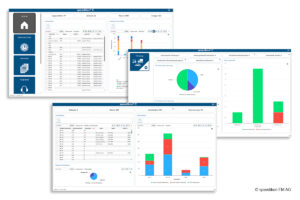
This is where an integrated CAFM platform can provide the necessary foundation. Rather than leaving asset information, processes, and documents in disconnected structures, speedikon® C brings existing data sources together in a connected platform and creates a consistent basis for facility operations.
The asset register becomes the central point of reference. Technical assets can be linked to rooms, rooms to buildings, buildings to organizational units, and operational processes to live data streams. Users no longer need to know which department or application holds a particular record. They can access the relevant information through the asset or location to which it belongs.
This does not mean replacing every specialist system. Existing sources and processes can remain in place while speedikon® C connects their information and makes it available through a reliable operational context. The result is a single source of truth that reduces duplicate records, unclear ownership, and conflicting versions.
Trust Is the Foundation of Operator Responsibility
As buildings become increasingly connected, the ability to preserve relationships between assets, operational activities and compliance records is becoming just as important as producing the records themselves Those that achieve this are better prepared when proof is required, while also improving transparency, reducing administrative effort and providing everyone with the same trusted foundation for informed decision-making.
If you would like to learn how speedikon® C helps organisations establish a connected information foundation for operator responsibility throughout the lifecycle of their buildings and technical assets, contact our team. We would be pleased to discuss your requirements in a personal consultation.