
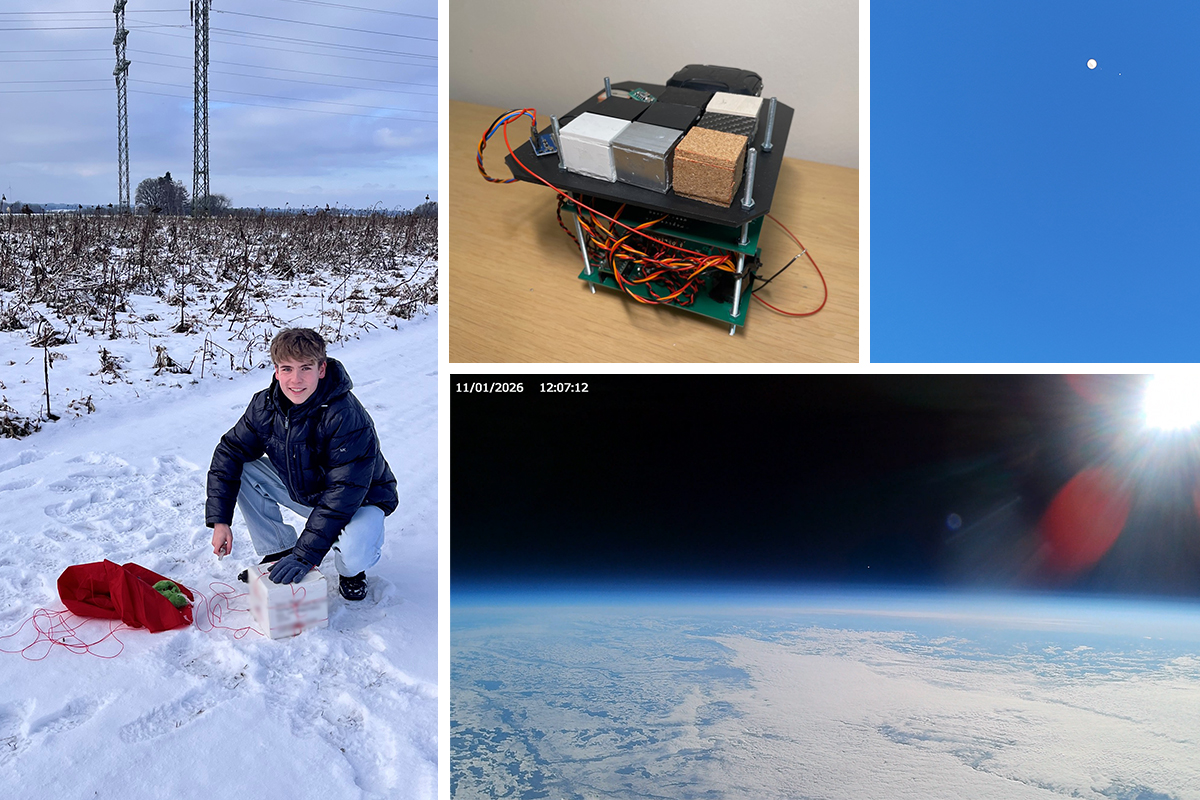
At 14, most students are busy deciding which subject to drop.
Julian Mayer, at 14, was asking himself how to measure ionizing radiation in the stratosphere and went on to develop his own measurement system to do just that.
Stories like this are so compelling because they show what can happen when curiosity is taken seriously. When young people don’t just learn what’s already known, but begin asking their own questions about the world.
At the speedikon group, we firmly believe that innovation doesn’t start in companies or research labs. It starts much earlier: in classrooms, in youth research competitions, and in minds that are simply given the freedom to explore. Julian’s project is a powerful example of this. It shows just how responsible, thoughtful, and forward-looking young researchers can be today.
And that this approach can even lead to first place in the Geo- and Space Sciences category of the “Jugend forscht” competition and qualification for the state-level finals.
In this interview, Julian talks about how his project came to life, what he learned along the way, and why the future of space exploration sometimes begins in a child’s bedroom.
Before we dive deeper: In your own words, what was your project about, why did you choose it, and how did speedikon FM AG support you?
“My project involved developing my own radiation measurement system to measure ionizing radiation in the stratosphere. The idea came from wanting to understand how radiation behaves as it passes through the atmosphere and different materials, not just in theory, but in measurable, real-world terms. Thanks to the support of speedikon FM AG, I was able to take the project to a whole new level. Their sponsorship made it financially possible for me to purchase high-quality precision components that are necessary to withstand the extreme conditions in the stratosphere. Without that support, the idea would never have turned into such a technically robust and reliable measurement system.”
Your measurement system didn’t stay in the lab. It actually flew on a stratospheric balloon. What was that moment like for you, and how did it differ from what you had imagined?
“The balloon launch was an incredibly emotional moment because months of work suddenly became real. What surprised me most was how windy, yet controlled, the ascent was, and how closely the actual flight path matched my calculations. At the same time, I realized that once the balloon was in the air, nothing could be fixed. Everything had to work perfectly beforehand.”
When did you realize this was more than just a school project?
“That was during the first successful dark test, when my self-built system actually detected individual radiation events. In that moment, I knew this was real physics and real measurement technology. From then on, I no longer saw it as just a school project.”
You deliberately chose to focus on the measurement electronics, even though comparing different materials might have sounded more spectacular. Why?
“Without a functioning and well-understood measurement system, material comparisons don’t mean much. It was more important to me to understand how radiation is detected in the first place and where the limits of measurement technology lie. The electronics are the foundation for everything else.”
What was the biggest mistake or setback during the project?
“The biggest setback was that the power supply became unstable in multi-channel operation, which meant I couldn’t run all measurement channels at the same time. That was frustrating, but also very educational. I learned a great deal about system integration and real-world technical limits.”
If you were explaining your measurement system to an engineer today, what would you be especially proud of?
“I’d be proud that the entire system was independently designed, built, and validated without relying on off-the-shelf kits. Especially the clean signal processing and the successful measurements in the stratosphere. And I’m proud that I was able to analyze the system’s weaknesses honestly.”
What did your project teach you about the very real limits of today’s space technology?
“I learned that space technology doesn’t fail because of a lack of ideas, but because of details like stability, noise, and power supply. Many problems only appear when everything comes together. That’s exactly why testing is so important.”
Was there ever a moment when adults underestimated your project? And what would you say to them today?
“Yes, at the beginning it was often considered too ambitious. Today I would say: Let young people experiment instead of setting limits too early. Learning often happens precisely where you’re not yet perfect.”
At the end of February, you entered your project in the ‘Jugend forscht’ competition and won first place in the Geo- and Space Sciences category. Congratulations! That qualified you for the state competition. What did that experience teach you about your project and about yourself as a researcher?
“As a researcher, I learned that mistakes aren’t dead ends. They’re often the most interesting moments. Before the competition, I thought everything had to run perfectly. But when I encountered the ‘sawtooth problem’ in the power supply, I realized that a real researcher doesn’t give up when something smokes or stalls. That’s when you really start digging. I learned that I have the persistence to work through complex data sheets until I find a solution. That gave me a lot of confidence for future projects.”
Imagine looking back at this project ten years from now. What do you hope it will have been for you: a beginning, just an experiment, or a turning point?
“I hope it was the beginning. The moment I understood that I can ask my own questions and answer them systematically. Maybe not a breakthrough, but a starting point.”
Picture: Julian Mayer