Crime scenes are temporary.
Once investigators leave, the environment changes. Rooms are cleaned, objects are moved, and streets reopen. What remains are photographs, sketches, and written reports. These records are essential, but they capture only fragments of what investigators originally saw.
Weeks, months, or even years later, investigators may need to revisit the case. By then, the scene itself no longer exists. They must reconstruct what happened from images, notes, and memory.
But what if the entire scene could be preserved exactly as it was and explored again at any time?
Turning a crime scene into a digital environment
FRAMENCE transforms traditional crime scene documentation into an interactive, photorealistic 3D environment that allows investigators, forensic experts, and judicial authorities to revisit the scene whenever necessary.
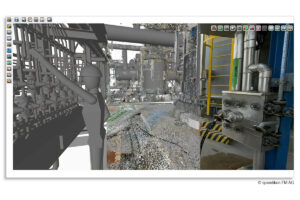
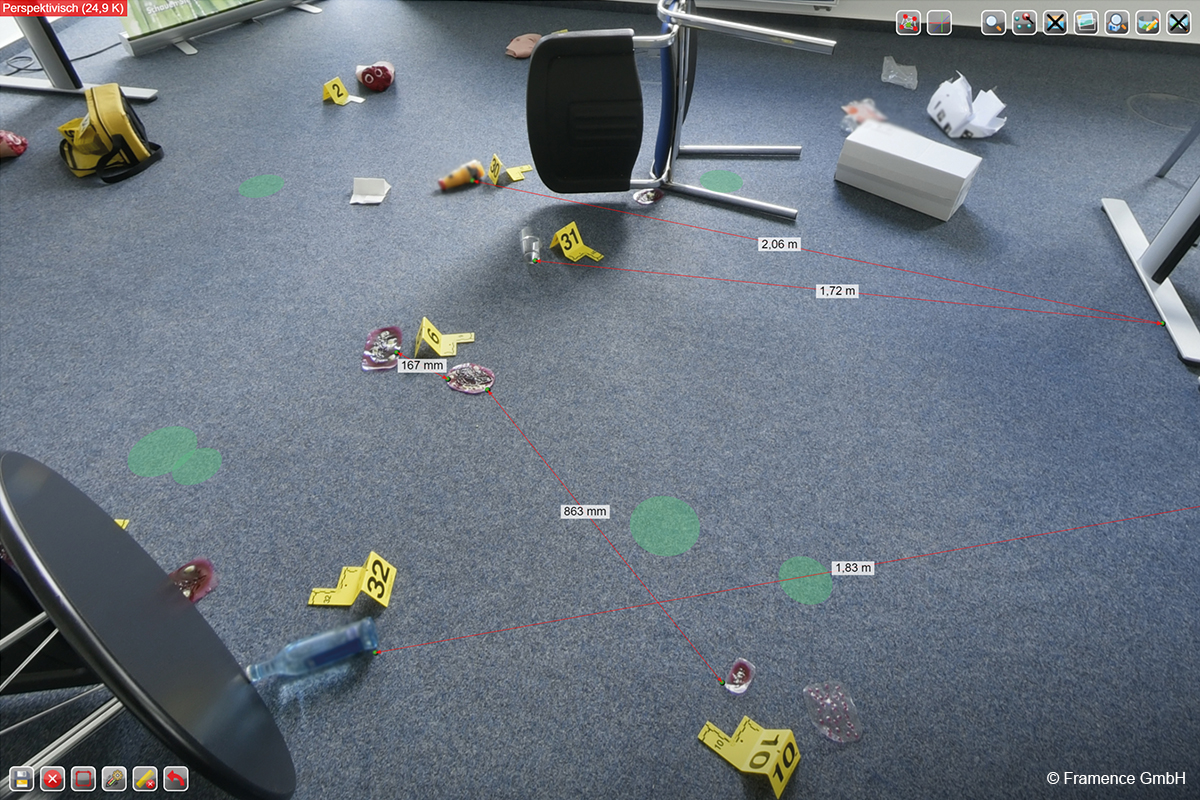
Using standard digital photographs from cameras, smartphones, or drones, the system automatically aligns images and reconstructs a highly accurate 3D digital twin of the scene. AI-based geometric modeling provides the spatial accuracy required for forensic analysis. Investigators can measure distances directly within the digital environment and access witness statements or notes from colleagues.
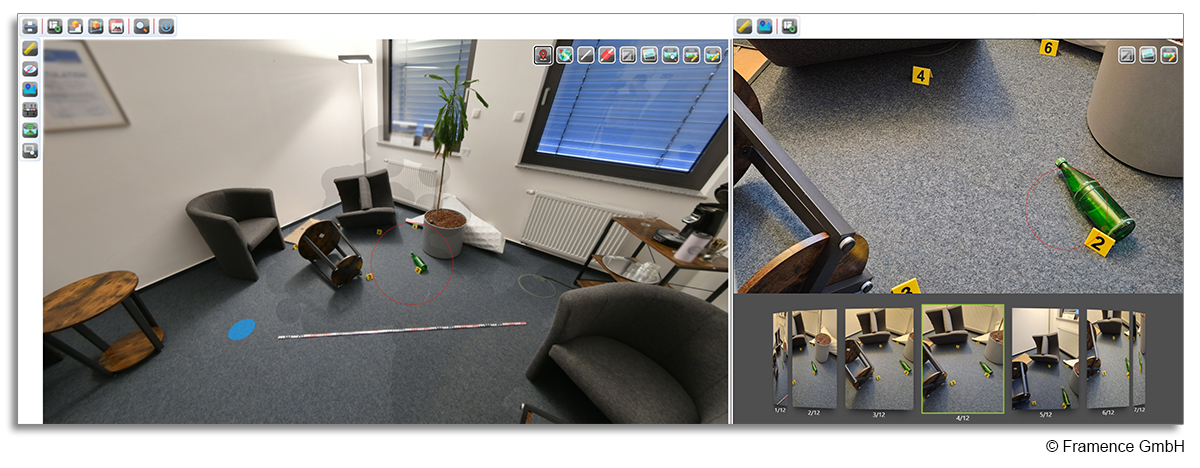
Instead of reviewing hundreds of separate images, investigators can navigate through a realistic reconstruction of the scene and examine details from different perspectives, similar to Street View.
All evidence within a shared spatial context
Investigations rarely rely on a single source of information. Photographs from first responders, drone footage, witness images, laser scans, CAD or GIS data, forensic lab results, and field notes are often stored across multiple systems.
FRAMENCE brings these elements together in one environment. Evidence can be georeferenced directly within the 3D scene, annotated, and linked to supporting documentation such as lab reports or case notes.
This creates a clear spatial framework for the entire investigation. Investigators can see where objects were located, how individual elements relate to each other, and how the scene developed. Built-in version control and a complete change log in FRAMENCE ensure that every modification remains traceable and that the chain of custody required in forensic work is preserved.
The photorealistic representation also makes the scene easier to understand for people without technical expertise. Prosecutors, judges, and other stakeholders can explore the environment visually instead of interpreting technical diagrams or complex models.
Collaboration and analysis beyond the original crime scene
The photorealistic digital twin created by FRAMENCE creates a shared reference point for everyone involved in an investigation. Investigators, forensic experts, and prosecutors can securely access the same scene and analyze evidence together, even years after the original documentation was created.
Role-based access ensures that sensitive information remains protected. The platform can run on-premises or in private cloud environments to meet strict data protection and sovereignty requirements.
The system can also support investigators with AI-based object recognition. This capability helps identify recurring items such as tools or weapons across scenes and cases.
From documentation to reconstruction
Imagine a burglary documented with ordinary cameras or even a smartphone. Within hours, these photographs can be transformed into a navigable 3D environment.
Investigators can analyze the placement of objects, evaluate whether witness statements align with the spatial layout, or share the reconstructed scene with experts in other locations, all without re-entering the original site.
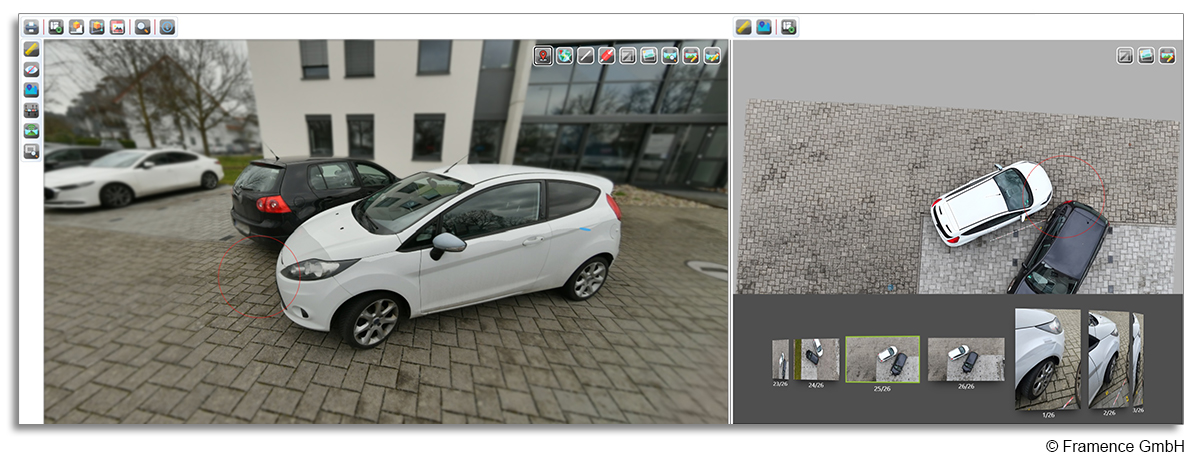
The same approach can be applied to outdoor incidents such as traffic accidents or large-scale emergency scenes, which can be captured quickly using smartphones, drones, or other recording equipment.
Preserving spatial context
Traditional photo or video documentation is inherently fragmented and inevitably loses part of the spatial context. Relationships between objects, distances, or viewpoints may remain unclear or may never have been captured from the right angle.
FRAMENCE preserves this context. The scene becomes a permanent, objective representation that can be revisited whenever new questions arise.
This allows investigators, forensic experts, and courts to work with a reliable digital reconstruction long after the original scene has disappeared.
Interested in seeing how this works in practice?
Contact the Framence team for a no-obligation demo:
https://www.framence.com/demo/
You can also explore more FRAMENCE case studies here:
https://www.framence.com/case-studies/
Picture: Framence GmbH