Energy and resource prices are currently highly volatile and continue to rise. In recent weeks, geopolitical tensions in the Middle East have further intensified market uncertainty, with the Iran conflict disrupting oil and gas supplies in Europe.
At the same time, legislation is continuously tightening the situation. As a result, most companies are concerned with how they can reduce their energy demand. Resource efficiency has long been a key focus, and particularly in modern production environments, operations are now optimized for energy efficiency. This raises the immediate question of where and how energy consumption can be further reduced.
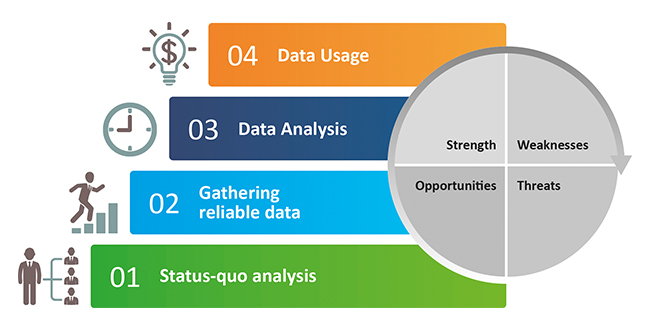
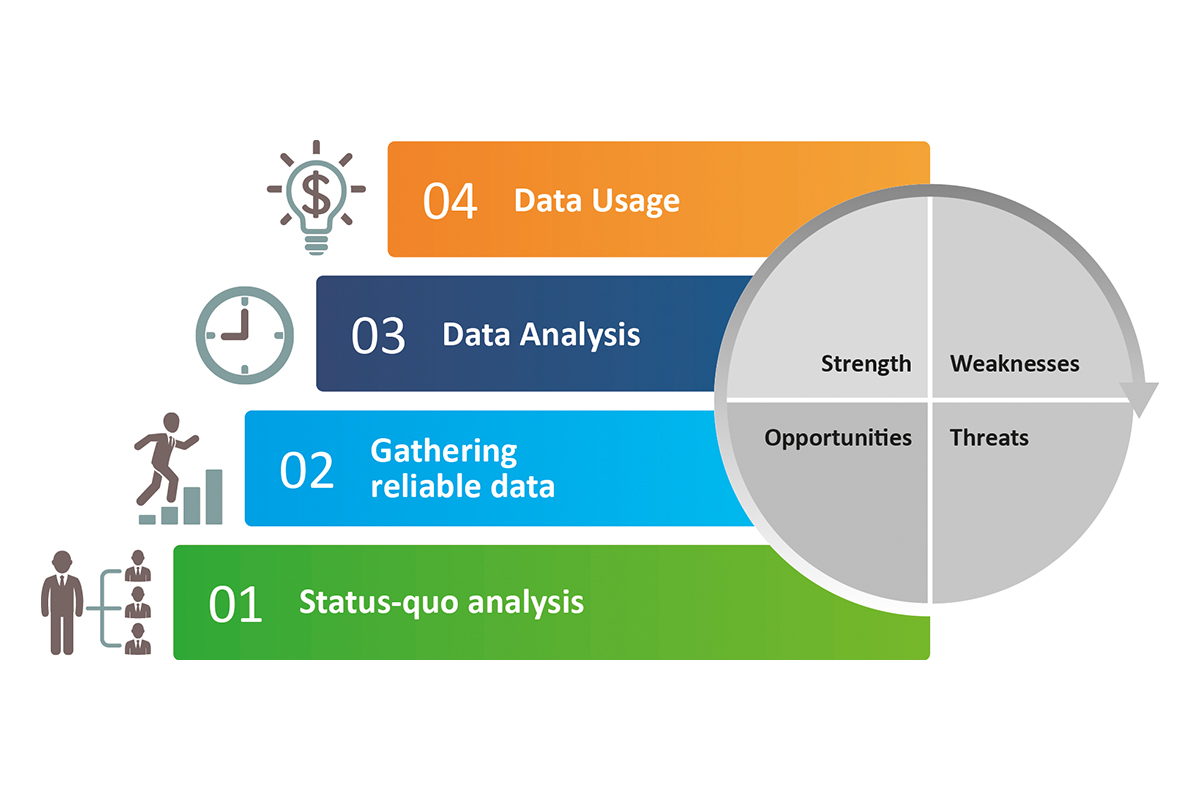
Based on our many years of experience, the speedikon Group has developed a four-step model, which we will now present in detail. At its core, the process consists of the following steps:
- In an initial analysis of the current state, we examine the extent to which energy-relevant aspects are already represented in business processes. Reviewing and assessing the available data sets is a crucial component of this analysis.
- In the second phase, usable data is identified to create the necessary transparency for specific efficiency analyses and monitoring. This includes gathering reference values and parameters essential for calculating key performance indicators.
- Since unmonitored data often ends up in “data graveyards,” making it difficult to derive reliable insights later, the third step of our 4-step model focuses on the ongoing evaluation and analysis of the collected data. This forms the foundation for effective energy management.
- Finally, we explore how the collected data can also be used for other, indirectly related processes. Many decisions in companies today already rely on information from the fields of energy and resources. Reliable data plays a critical role in improving decision-making and avoiding costly mistakes.
What does this mean in detail?
Procurement of the Necessary Data
When implementing energy management processes, the question always arises as to where the required data comes from and how it can be collected. Each customer has a different infrastructure, requiring a variety of methods to fully access the data treasure trove. This also includes integrating existing third-party systems.
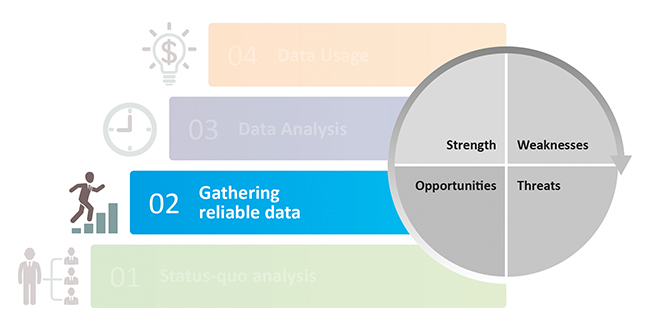
To identify the optimal methods of data acquisition, consultants must work closely with the respective users. In personal discussions, the technical conditions are clarified, and individual needs are explained. The results of these discussions form the basis for implementing tailored solution approaches.
Portfolios often consist of numerous buildings and facilities that have been built and equipped over many years. A homogeneous metering structure is often lacking due to the historical installation of devices from various manufacturers. Additionally, data acquisition and collection systems often already exist that can provide data. The goal is always to continue using all existing devices and systems to keep investment costs in new hardware as low as possible. Therefore, implementers must always assess which acquisition or transmission methods are ideally suited.
Integration of Common Protocols
Professional energy management software must be capable of communicating with common protocols such as Modbus, OPC, or BACnet. The software should also seamlessly integrate innovative new approaches such as LoRaWAN. Only then can data be collected easily, quickly, and cost-effectively, even in distributed infrastructures. Additionally, existing collection systems such as building automation systems (GLT), process control systems, or other databases are integrated via IT interfaces.
Utility provider data can be integrated into the software via email or file import. Furthermore, analog meters can be recorded manually on a regular basis using an app or potentially integrated via LoRaWAN add-ons.
This entirely vendor-neutral approach allows for seamless acquisition of all existing data and helps to avoid or minimize the need for new hardware purchases.
Always Validate Data
Because data quality is crucial for functioning processes and reliable evaluations, all incoming data is checked for plausibility both formally and substantively.
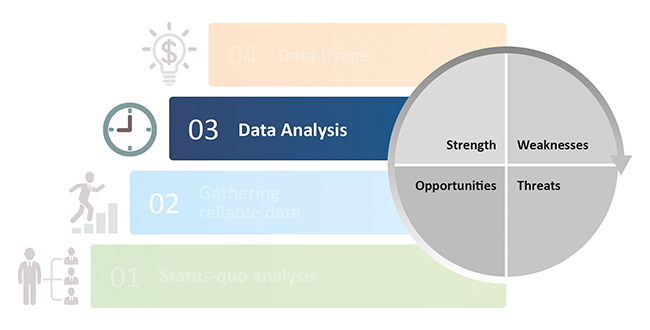
An energy data management system must be capable of handling millions or even billions of data records and making them available for evaluations in the shortest possible time. The data must be presented clearly. It is also important that the software can relate this data from various sources in terms of time and logic. In doing so, the quality—that is, the correctness and plausibility—of all data and processes based on this data must be ensured. Ideally, this task is handled by appropriate validation tools integrated into the management solution. The following steps must be fulfilled:
- Data is checked formally for plausibility
- It is verified whether a value was transmitted at all
- It is verified whether each value is transmitted from the correct source
- A watchdog checks the content of the data
- It ensures that certain limit values are maintained, which are typically defined by the customer based on historical data
If deviations are detected during data monitoring, good energy management software offers a range of tools and functions to ensure high flexibility in evaluation so that anomalies can be identified and corrected. For evaluation, the application prepares all required data according to the selected time periods and intervals and displays them graphically – even large volumes of data should be shown without disruptive delays. Using an integrated chart component, various graphical data analyses should be possible, such as status bars, multi-charts, or scatter plots. All data to be evaluated is retrieved live from the database, ensuring high flexibility. Configured charts must be savable as views and be updateable and retrievable with current data at any time.
Comprehensive Integration Makes Sense
As reports are typically already standardized according to company-specific requirements, they only need to be filled with reliable data in an optimized way. Here, energy management software can support the process with a report generator. With such a tool, even highly complex reports can be created with ease. For example, various dashboards can be created for individual buildings, showing energy consumption over the past months or even years. Additional accompanying information, such as the address or precise square footage of each property, can also be included. This provides an information overview per building, allowing large deviations in energy consumption to be identified and appropriate actions to be initiated.
A formula editor is also highly recommended. It enables in-depth analysis of measurement data and the representation of mathematical relationships between measurement data and characteristics of buildings, machines, and systems. Ranging from simple summations to highly complex mathematical calculations, such a formula editor proves to be a powerful analytical tool, allowing data to be thoroughly examined and evaluated.
All of these tools provide reliable evaluations that help you not only make the right decisions to improve your company’s energy efficiency but also use the gathered data for other areas of your business, such as billing.
Reusing the Acquired Data
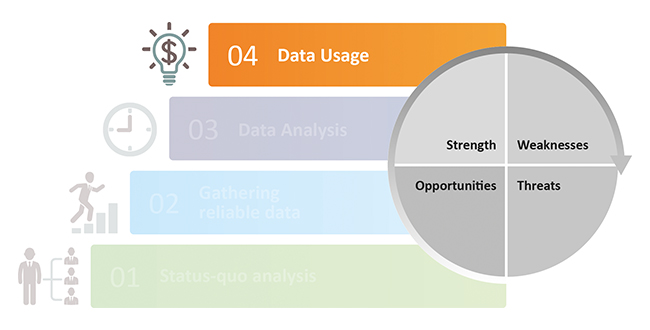
A well-designed energy management software also takes into account downstream administrative and subsequent processes. These must be reflected in many companies and organizations and be supported with appropriate resource consumption data. For many of these processes, which are directly related to energy and resource consumption, the software should offer customized solutions that precisely support all workflows for users’ daily operations. This kind of process support enables companies to achieve their internal efficiency goals more easily.
Allocating Costs to the Originator
Due to the high costs of energy and resources, cost allocation to individual consumers is essential. In addition to simple cost distribution, the resulting transparency is also an important (educational) factor in achieving energy savings.
Various options and methods are available for performing such cost allocations. From simple reallocations based on defined keys such as floor area shares to complex, multi-stage billing workflows based on flexible, time-variable rules, the software must enable users to allocate individual energy and resource costs transparently and in a cause-related manner.
Special Case: Energy Consumption in Production
Companies that are serious about improving their energy efficiency must also be able to determine the energy demand of their production processes. Only when it is known how much energy and resources are used for individual production steps can strategies for energy optimization be developed. In such cases, innovative batch management methods help. They make it possible to determine the exact energy and resource amounts and cost items for each production step and each individual batch. As a result, outliers, inefficiencies, or other unusual consumptions are immediately visible. By including CO₂ equivalents, the growing requirements for carbon footprint information can also be met with ease.
The Ultimate Discipline: Accurate Forecasts
For companies with high energy costs, accurate forecasts of future energy and resource demand are absolutely necessary. Only if it is known how much energy will be needed and when can better purchase conditions be secured or one’s negotiating position with the utility provider be improved. With this in mind, energy management software must provide various forecasting tools to predict future energy demand accurately.
Depending on the use case, these forecasts must be able to cover different time periods. For load management, short-term intraday forecasts are needed to predict short-term fluctuations and take corrective measures such as load shedding, shifting, or reduction. Using longer-term forecasts, such as daily or weekly predictions, energy purchasing can be optimized and costs reduced. In addition, these forecasting methods can also be used for long-term production runs or capacity planning.
Energy Management Software Creates Transparency and Savings
To be maximally effective, energy management software must meet several requirements. It must be well networked within the company with other applications, systems, bus structures, and control technologies to work on a reliable information basis. It must be capable of reading in diverse data, validating it, and correctly assigning it to sources and causes. It must provide reliable evaluations, analyses, and trustworthy forecasts. And it must be easy to use — only then can it reliably fulfill its purpose, not only delivering financially valuable results but also gaining high user acceptance.
To effectively manage rising energy costs and increasing regulatory demands, having the right tools in place is essential. Wiritec C provides the transparency and control needed to reduce energy consumption and manage costs more efficiently.
Ready to take control of your energy consumption? Contact us and find out how digital energy management can make a measurable difference in your operations.
Images: WiriTec GmbH