The Bundesfachtagung Betreiberverantwortung is one of the most relevant industry gatherings in Germany for professionals responsible for the safe and compliant operation of buildings and technical systems. On April 20 and 21, 2026, experts, operators, and decision-makers will meet in Fulda to discuss regulatory developments, operational risks, and practical strategies for managing increasingly complex infrastructures.
The relevance of operator responsibility has increased significantly in recent years. Organizations are facing rising compliance pressure as ESG requirements expand, audit scrutiny becomes more rigorous, and liability risks for operators and management continue to increase.
Focus on responsibility in a complex environment
In practice, operator responsibility is shaped less by individual regulations and more by their interaction. Technical systems, documentation requirements, and digital tools are increasingly interconnected, yet often not integrated.
Three structural challenges are particularly visible:
- Regulatory density: Requirements are increasing not only in number, but also in depth, particularly in areas such as safety, ESG reporting, and operational documentation.
- System fragmentation: CAFM systems, spreadsheets, and legacy tools often coexist without a consistent data model, making it difficult to maintain a single source of truth.
- Liability and audit pressure: In the event of incidents, organizations must prove that obligations were fulfilled.
At the same time, many organizations are investing in digitalization but struggle to scale it. AI and data-driven maintenance approaches often remain stuck in pilot phases, limiting their impact on day-to-day operations
This raises fundamental questions:
- How can risks be identified before they materialize?
- How can data from different systems be consolidated into a usable decision basis?
- How can organizations ensure that every action remains traceable under audit conditions?
These are precisely the questions that define operator responsibility today and that will be addressed at the event in Fulda.
AI in the context of operator responsibility
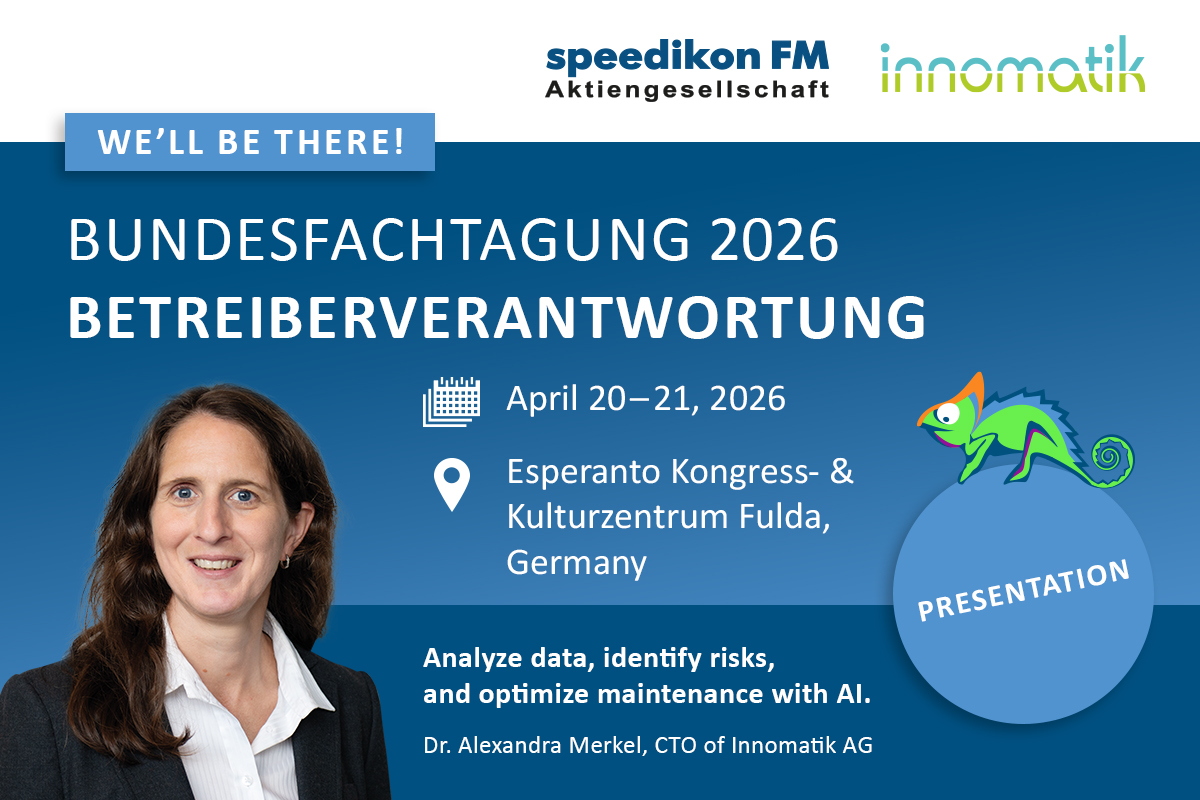
As part of the conference program, Dr. Alexandra Merkel, CTO of Innomatik, will present how artificial intelligence can be used to analyze building data, detect risks early, and optimize maintenance strategies.
In practice, AI systems process large volumes of data from different sources such as CAFM platforms, IoT sensors, maintenance histories, and inspection reports. Instead of simply storing this data, machine learning models analyze it continuously to identify patterns and deviations.
This enables several concrete capabilities:
- Early risk detection: Identifying anomalies in system behavior before failures occur
- Pattern recognition: Detecting recurring issues across assets or locations
- Dynamic maintenance planning: Adjusting maintenance intervals based on actual condition rather than fixed schedules
- Decision support: Providing recommendations based on data correlations rather than isolated observations
These approaches are no longer theoretical. Analytics-based maintenance can reduce maintenance costs by 18 to 25 percent. At the same time, data-driven maintenance improves uptime by enabling earlier intervention and reducing unplanned failures.
This is not just an efficiency gain. It represents a shift in how responsibility is managed.
Exchange and discussion on site
We are looking forward to exchanging ideas with industry professionals, discussing current challenges, and exploring how digital approaches can support organizations in managing operator responsibility more effectively.
If you would like to explore the topic further or connect directly with the speaker, feel free to contact us at info@speedikonfm.com.
Further information about the event and registration can be found here:
https://www.facility-manager.de/betreiberverantwortung/?C=7126/1
Picture: speedikon FM AG