A pump is due for replacement in a technical room that has been modified several times over the past decade. The maintenance system contains its asset number and service history, while the drawings show the original layout. Yet the team preparing the work still needs to establish which pump is installed today, how it can be reached and whether the replacement will fit through the available access route. The information is not necessarily missing; much of it simply lacks a clear connection to the place where the work will happen.
For facility managers and technical operators, such situations are familiar. Buildings and industrial facilities evolve through countless small interventions, while documentation accumulates across projects, departments and software systems. A digital twin for existing facilities becomes valuable when it connects that fragmented knowledge with a recognisable view of the physical environment, helping people make better-informed decisions without creating another isolated information repository.
The gap between a record and a real place
An asset register may be carefully maintained and still leave a contractor standing in front of three similar pumps, unsure which one the work order refers to. A drawing may accurately describe the original installation but omit a later pipe diversion. Photographs can fill part of the gap, although an image saved without a reliable location is difficult to interpret months later. These uncertainties become particularly costly when internal teams and external specialists need to coordinate work without being in the same room.
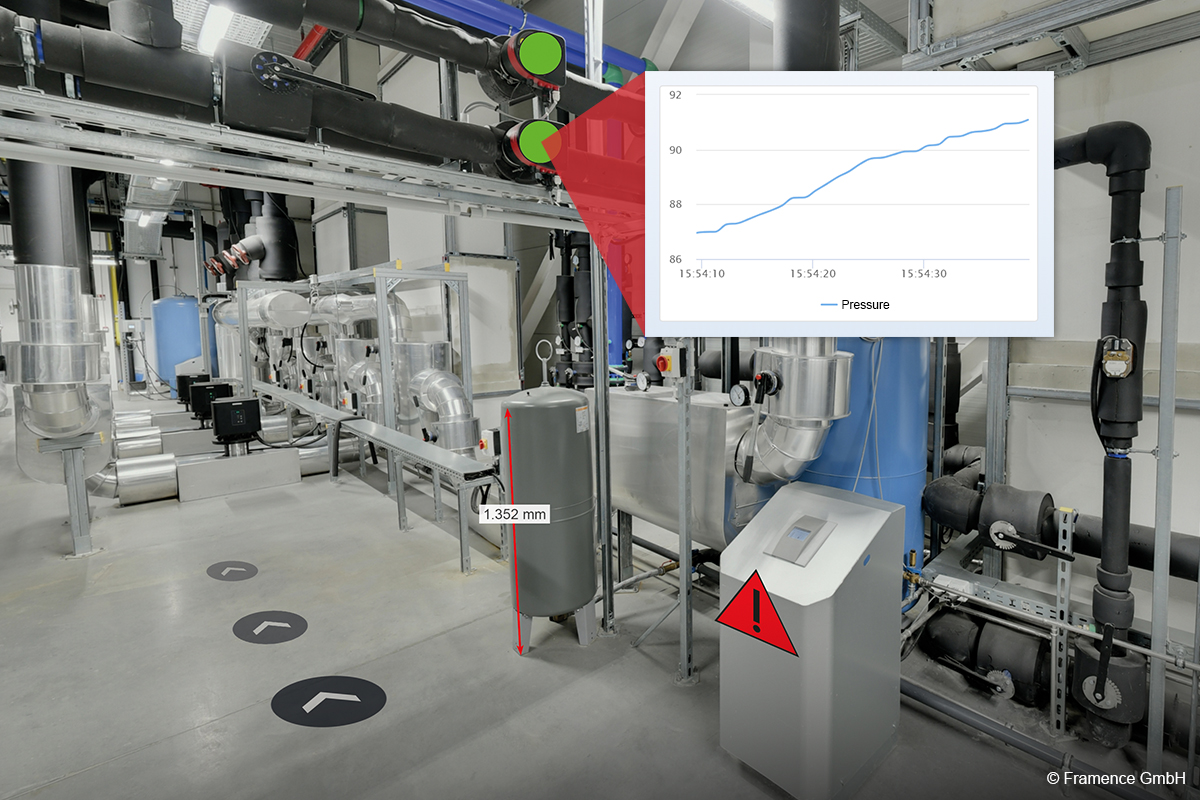
A photorealistic digital twin gives everyone involved a shared view of the facility. Instead of starting with an equipment code, users can navigate to the technical room, recognise the pump and examine the surrounding installations. With FRAMENCE, they can also measure distances and dimensions directly in the digital twin, checking access routes and available space before the work begins. A planner and service provider can assess whether the replacement can be brought into position and identify potential obstacles remotely, making the next site visit more productive.
The same spatial context makes day-to-day maintenance communication more precise. If a technician discovers a leak near a valve, they can place a Point of Notification (PoN) at the affected location rather than describing it vaguely in an email. Colleagues and service providers see where the problem is, what needs attention and any relevant instructions before arriving on site. As the repair progresses, the notification can be updated and ultimately marked as completed, giving everyone involved a clearer picture of the work without lengthy exchanges to establish which installation is meant.
When information stays connected to its location
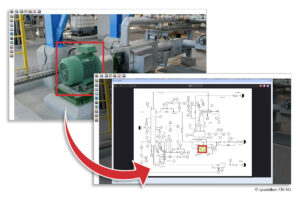
FRAMENCE turns photographs into a browser-accessible, photorealistic digital twin in which technical information is available where people need it. Points of Information (PoI) connect documents and other records to positions in the 3D coordinate system. A technician examining a control cabinet can open its operating instruction directly from the visual environment, while a planner can review the relevant documentation alongside the surrounding equipment. Information that would otherwise be spread across folders and applications becomes easier to find because it is connected to the physical place people recognise.
Consider a service provider preparing to repair that pump. Before travelling to the site, they can locate the equipment in the digital twin, review its technical documentation and see the reported fault in context. The internal maintenance team can add information as the situation develops, so the contractor arrives with a clearer understanding of both the installation and the task. This is particularly valuable when different teams are responsible for identifying, planning and carrying out the work.
Where connections to external systems have been configured, FRAMENCE can also make relevant records accessible in their spatial context. Maintenance histories, work orders and approved documents can remain in the applications that manage them, while users find their way to the right information through the facility itself. Administrators can manage user permissions and access rights, allowing internal teams and external service providers to work with the information and functions relevant to their responsibilities.
FRAMENCE’s browser-based access makes this shared view available without requiring every participant to work in the same specialist application. For organisations with particular data security or infrastructure requirements, the platform also supports on-premises deployment. That option is especially relevant in sensitive industrial environments and critical infrastructure (KRITIS), where the choice of operating environment is an important part of the wider IT strategy.
Existing facilities do not stand still
After a refurbishment, it may be difficult to reconstruct where a pipe previously ran or which component has been removed, especially when several contractors have worked in the same area. The Timeline function allows users to navigate between documented visual states and understand how the physical environment has changed. A planner preparing another modification can compare earlier and later views rather than relying entirely on drawings or colleagues’ recollections.
Updating the visual record does not mean rebuilding the links to technical information. Because PoI are anchored in the 3D coordinate system rather than to individual photographs, they remain at their positions when new images are uploaded. A technician can still find an installation’s documentation where the equipment stands, even after the room has been refurbished. Combined with the Timeline, this makes it easier to follow physical changes without losing the information needed for ongoing operations.
As equipment is replaced or removed, the associated information can be kept in step with the actual installation: PoI can be edited or terminated as needed. The twin therefore remains useful beyond the initial documentation project, supporting the next maintenance task or modification with a visual record and spatial information that reflect the changing facility.
The value is in the next decision
The strongest starting point for a digital twin project is often a recurring operational problem rather than the ambition to document every room. Teams may spend too long identifying equipment, clarifying the location of faults or preparing modifications with incomplete knowledge of the space. Addressing those situations first helps organisations focus their visual documentation and information links where they can improve daily work most.
For facility managers, asset owners and technical operators, the benefit is a shared understanding that supports both information access and practical action. People can see which installation they are discussing, retrieve relevant documents, communicate required work and follow changes to the physical environment. The digital twin becomes part of daily operations when it helps turn knowledge about a place into a clearer next step.
Still piecing together information about existing facilities from site visits, drawings and separate systems? Explore how FRAMENCE makes the physical environment a starting point for information access: https://www.framence.com/platform/