There are moments in everyday work life when you briefly forget that you are sitting in a perfectly ordinary meeting room. Because suddenly, standing at the front of the room is a 14-year-old talking about things that make even experienced engineers raise their eyebrows in amazement.
That was exactly the kind of moment we experienced on May 5 in Bensheim, Germany.
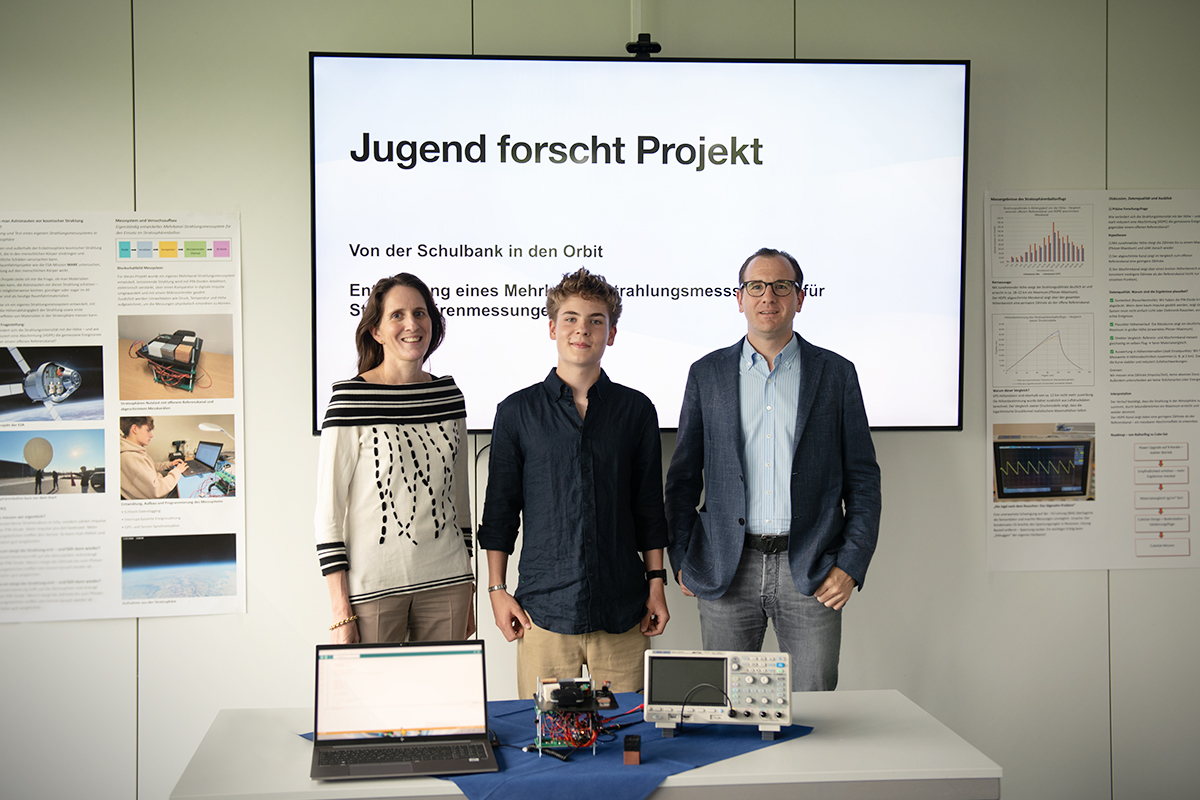
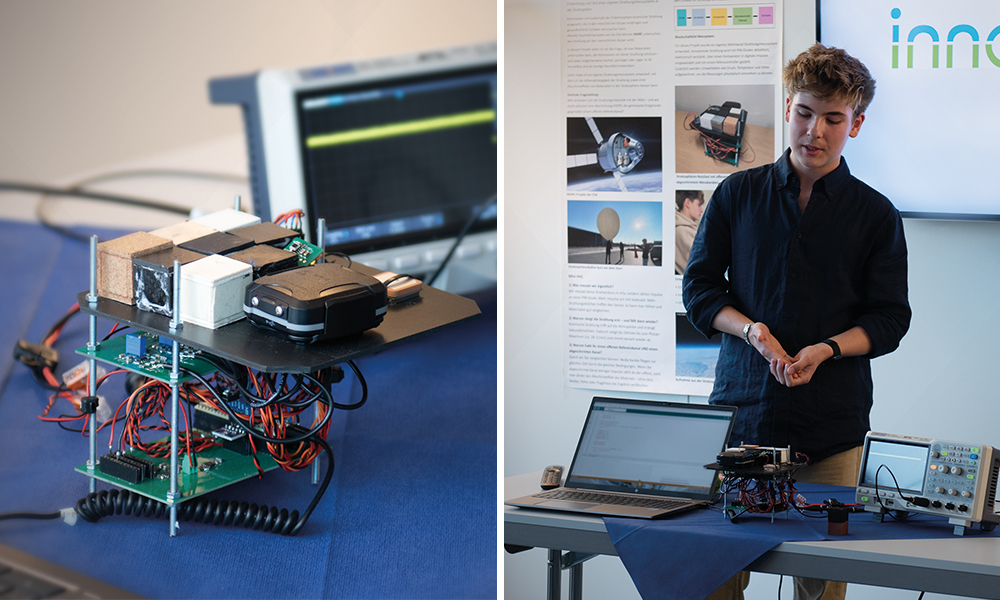
On that day, young researcher Julian Mayer presented the project that had recently won first place at the Hessen state finals of the “Jugend forscht” competition, a project we had the privilege of supporting from the very beginning. His presentation impressed not only our colleagues, but also members of the press and experts from the aerospace industry, including representatives of the German Society for Aeronautics and Astronautics (DGLR). And within just a few minutes, it became clear that this was no ordinary student research project.
The question that started it all: What actually protects us from cosmic radiation?
While many 14-year-olds might be thinking about which smartphone to ask their parents for next, Julian was asking himself a very different question: Which materials are best suited for shielding against radiation in space? More specifically: can hydrogen-rich materials reduce cosmic radiation particularly effectively?
It’s a question that is not only fascinating from a scientific perspective, but could also become highly relevant for future space missions. Julian did what real researchers do: he decided to find the answer himself.
“Then I’ll just build the measurement system myself.”
And this is where the story becomes absurdly impressive.
Instead of buying ready-made equipment or relying on existing systems, Julian simply developed his own modular multi-channel measurement system for detecting ionizing radiation.
Completely on his own.
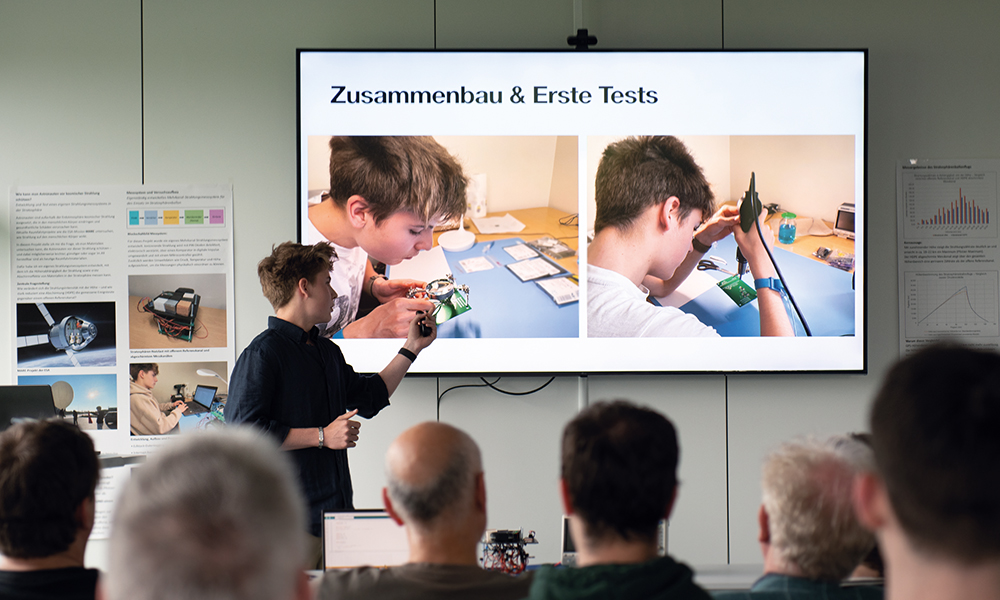
He taught himself Python, learned how to use specialized measurement and data analysis software, designed electrical circuits and schematics, taught himself soldering, and produced his own circuit boards. In short, while other teenagers his age might be building LEGO models, Julian is building radiation measurement systems for the stratosphere.
Before the system was even allowed to launch, he first carried out a dark test to ensure the sensors were working correctly and that no external influences would distort the measurements.
“What fascinated me was really understanding every part of it myself, from the electronics to the data analysis,” Julian explains. “I didn’t want to simply carry out an experiment. I wanted to develop the entire system myself.”
A Road Trip Meets a Space Mission
But Julian did not want to make measurements in the classroom. He wanted real conditions. So he planned a stratospheric flight.
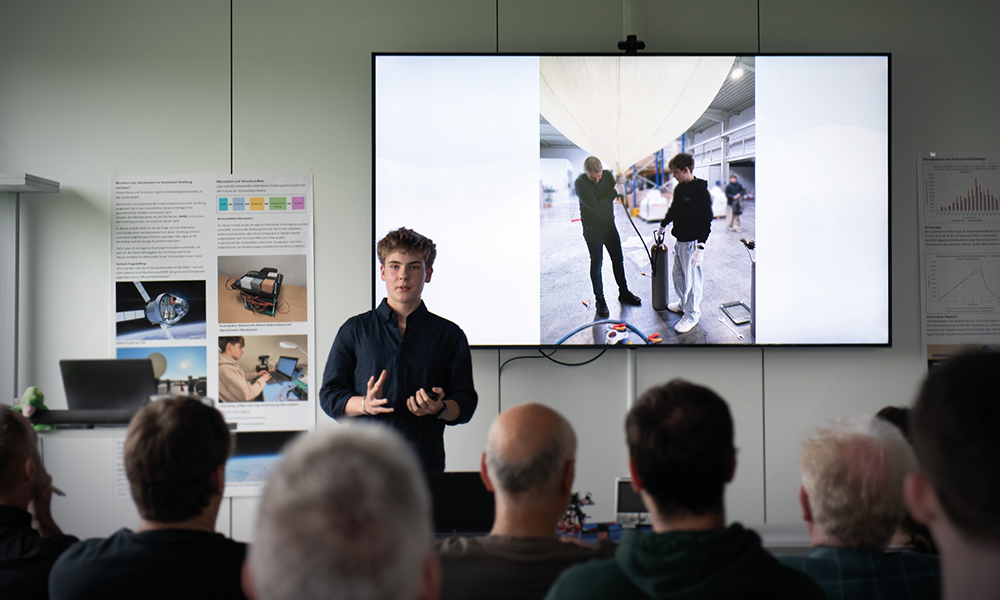
To make that happen, he independently applied for official flight approval from the Darmstadt Regional Council, calculated the balloon’s flight path himself, and planned the entire mission, including launch in Darmstadt, drift trajectory, and landing near Munich.
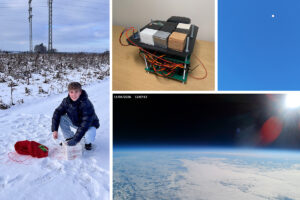
And anyone imagining a small weather balloon experiment: The balloon was filled with helium and ascended deep into the stratosphere, which extends up to around 50 kilometers above Earth. Julian’s major goal was to reach the 40-kilometer mark, since that is about as high as a stratospheric balloon can realistically go. In the end, the balloon reached an impressive altitude of 38 kilometers. Not quite the target, but still extremely close to the boundary of space and absolutely extraordinary for a self-planned student project. As the balloon rose through the thin atmosphere, it expanded to a gigantic diameter of 14 meters.
At times, the balloon raced through the atmosphere at speeds of up to 250 km/h, and the entire flight lasted two and a half hours. Throughout the mission, the system remained in constant contact with Julian. During ascent, flight, and landing, the measurement system continuously transmitted GPS coordinates in real time, allowing him to track the balloon’s route live and know exactly where it was at every moment.
While the balloon drifted across southern Germany, Julian and his father followed it by car, chasing it all the way from Darmstadt to the Munich area.
Landing Somewhere Between a Field, Forest, or City
One of the biggest challenges of missions like this is that you never know exactly where the system will land. Still, the odds were largely in Julian’s favor. Since large parts of Germany consist of forests and agricultural land, there was a good chance the measurement system would come down somewhere in an open field.
And in fact, the flight path Julian had calculated turned out to match the actual route almost perfectly. During descent, the balloon burst automatically as planned, the parachute deployed on its own, and the system eventually landed safely in an open field near Munich.
Even then, luck still played a role, as the system landed near power lines. Julian had prepared for almost every possible scenario and even brought ropes and a long pole in case he had to retrieve the system from trees or other obstacles. But power lines were one thing he had not planned for. Fortunately, the probe drifted safely past them.
Mission accomplished.
And presumably, nobody in Bavaria had expected that a self-built radiation measurement system from the stratosphere would land right next door that day.
Excitement Among the Press and Aerospace Experts
During the presentation, the conversation quickly turned into an in-depth technical exchange with the aerospace experts in attendance. What impressed guests most was the combination of scientific depth, technical execution, and extraordinary personal initiative.
Our CEO Adrian Merkel was equally impressed:
“Julian reminds us what innovation is really about: trying things out, building, failing, improving, and simply getting started. What he has achieved at the age of 14 impresses even experienced developers. These are exactly the kinds of people the future needs. We are proud to support him on his journey and beyond.”
What Comes Next?
Standing still is clearly not Julian’s style.
He will soon begin an internship at the German Aerospace Center (DLR). His long term goal is to collaborate with the European Space Agency (ESA). And after seeing this project, that no longer sounds like an unrealistic dream. It feels more like a very logical next step.
Honestly, we would not be surprised if one day a rocket carrying technology developed by Julian launches into space.
Why This Story Inspires Us
For us, this visit was a reminder of how real innovation happens: not through perfect conditions, but through curiosity, enthusiasm, and the willingness to simply build things yourself. These are values that our research team at the speedikon FM group lives by every single day.
Julian taught himself advanced knowledge, mastered complex technologies, solved problems independently, and carried out an entire miniature space mission. At the age of 14.
We warmly congratulate Julian on winning first place at the “Jugend forscht” state competition in the field of geo and space sciences. We are incredibly proud to have accompanied him on this journey and, of course, look forward to continuing to support him in the future.