Over the past decades, industrial companies have carefully archived their technical drawings. When digitization became the priority, these paper plans were scanned and stored on servers, creating what seemed to be a modern and efficient archive.
While this step was necessary, it often created a new challenge. Instead of physical folders, organizations now manage extensive digital archives filled with thousands of scanned files. Searching for a specific drawing frequently means navigating complex folder structures, opening multiple PDFs, and relying on inconsistent file-naming conventions.
The result is not a lack of data, but difficulty in accessing the right information at the right time.
When Digitization Alone Is Not Enough
In many cases, valuable knowledge is embedded directly within the drawings themselves. Room labels, component descriptions, handwritten annotations or stencil lettering contain essential operational information. However, traditional document management systems typically search only metadata such as file names or manually assigned tags. This means that the most relevant content inside the drawing remains invisible to standard search functions.
Older plans present an additional challenge. Historical formats, faded lettering, or scanned blueprints are often considered difficult to process digitally. As a result, large portions of archived knowledge remain underutilized, even though they are technically available. To truly unlock the value of existing plan archives, the search must go beyond file names and access the actual content of the drawings.
A New Approach to Plan Search
inno:plan, developed by Innomatik, introduces an AI-powered graphic search that analyses scanned plans directly at content level.
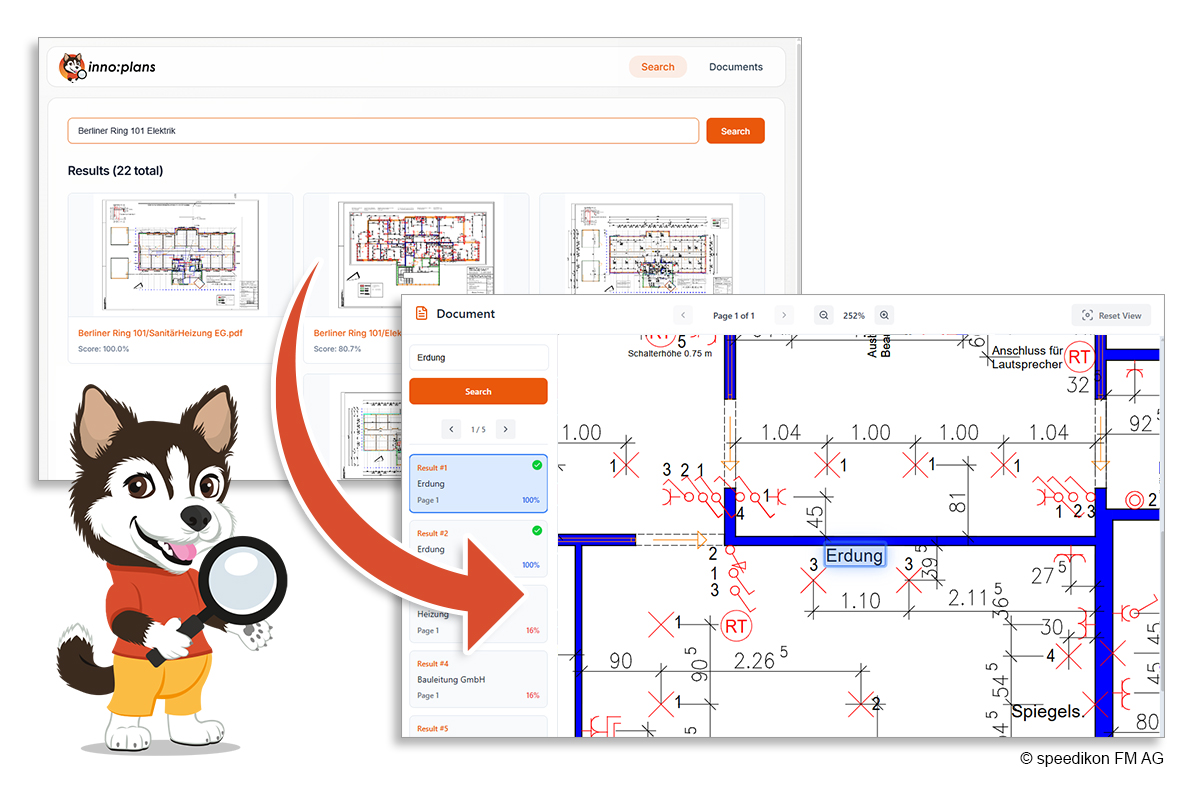
Using advanced OCR technology, the system processes text elements within drawings, including older plans, stencil lettering and scanned documents. If information is visually readable, it can be recognized and indexed. This allows companies to search their archive using natural language queries and retrieve relevant plans within seconds.
More importantly, inno:plan does not stop at identifying documents. It highlights the relevant information directly within the drawing. For example, users can search for specific rooms, technical components or designations and immediately see where they appear in the plan.
The system runs entirely on-premise, ensuring full data control without cloud dependency.
Turning Archives into Working Tools
The objective of inno:plan is not to create new data, but to activate the value of existing information. Instead of reorganizing archives or introducing additional manual tagging processes, the solution connects users directly with the knowledge already stored in their drawings.
For Corporate Real Estate Management, asset operations and industrial environments, this means faster access to relevant documentation, reduced search effort and more efficient workflows.
By transforming static archives into searchable, context-aware information sources, inno:plan lays the groundwork for more informed decisions and improved operational transparency.
Experience inno:plan with Your Own Data
Many organizations are surprised to see how much valuable information is already available within their existing plan archives.
If you would like to see how inno:plan performs with your own plans and documents, we invite you to contact us. We are happy to demonstrate inno:plan using real data and show how content-based search can simplify everyday work.
Picture: speedikon FM AG